Giving Without Measure: Rediscovering the Ancient Practice of Dana in Everyday American Life
In the Pali canon — the scriptural foundation of Theravada Buddhism — the Buddha described dana, or generosity, as the first and most fundamental of all virtues. Before ethical conduct, before meditation, before wisdom, there is giving. This sequencing is not accidental. The act of releasing attachment to what one possesses — whether material wealth, time, skill, or attention — is understood as the essential first movement of the spiritual life.
For the Thai immigrant communities that have established flourishing temple communities throughout the United States, dana is not an abstract philosophical concept. It is a lived practice, woven into weekly temple visits, seasonal festivals, and the fabric of daily life. But as these communities deepen their roots in American soil, and as growing numbers of American-born practitioners encounter Thai Theravada Buddhism, a rich conversation is emerging: How does this ancient principle translate into the specific textures of contemporary American existence?
The Classical Understanding
Dana, in its classical formulation, refers to the voluntary relinquishing of something one values for the benefit of another, without expectation of return. The Pali texts identify three primary forms: material giving (āmisa-dana), the gift of protection or freedom from fear (abhaya-dana), and the gift of Dhamma — sharing teachings and wisdom (dhamma-dana).
The merit generated by dana is understood to arise not primarily from the magnitude of what is given, but from the purity of intention behind the gift. A small offering made with a clear, joyful, and unattached mind is considered more spiritually valuable than a large donation made from habit, social pressure, or the desire for recognition. This emphasis on inner quality over outward quantity distinguishes dana from philanthropic models that measure impact primarily through financial metrics.
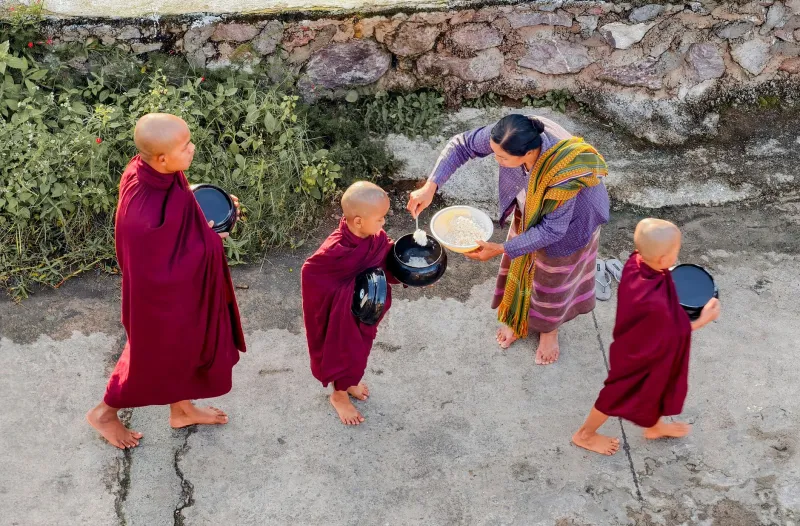
"In Thailand, even a child putting rice in a monk's bowl in the morning is practicing dana," explains Phra Ajahn Wichai, who has taught Dhamma at Thai temples in California for more than fifteen years. "It is not about how much. It is about the heart that gives."
Temple Giving in the American Context
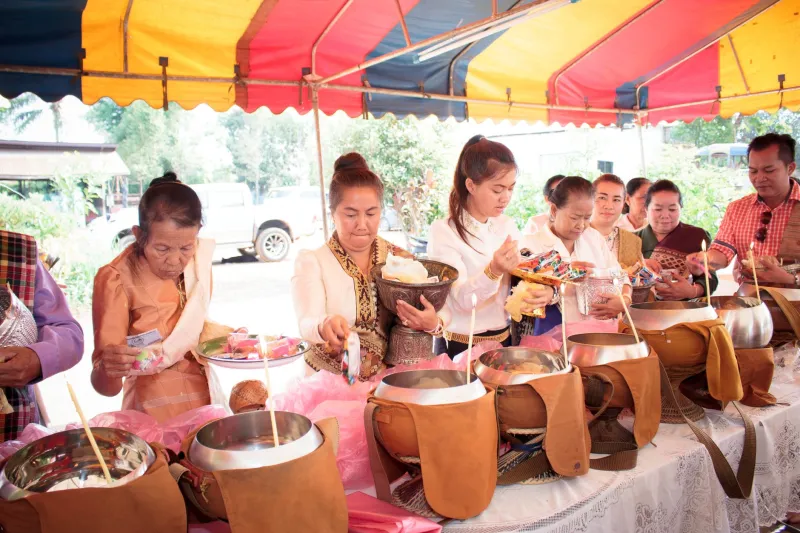
For Thai Americans, the most familiar expression of dana remains the temple offering. Preparing food for monks, contributing to building funds, sponsoring ceremonies, and donating supplies for community events are all understood as meritorious acts that cultivate generosity as a character quality rather than merely as a transaction.
Yet even within temple communities, practitioners describe a process of reflection about what giving means in the American context. Temples here operate without the governmental and cultural support structures that sustain religious institutions in Thailand. Monks depend entirely on lay support. Buildings require maintenance. Community programs need funding. The practical stakes of dana are, in some respects, higher and more visible.
Many temples have responded by creating transparent giving structures — itemized donation categories, merit-making sponsorship packages for ceremonies, and clear communication about how contributions are used. This transparency, while perhaps more American than traditionally Thai in its emphasis on accountability, reflects an adaptive intelligence that honors both the spirit of dana and the expectations of a community accustomed to institutional accountability.
Beyond the Temple: Dana in Civic Life
For both Thai immigrants and American converts, one of the most generative questions in contemporary Buddhist practice is how dana expresses itself beyond the temple gate. The answers that practitioners offer are diverse, thoughtful, and often surprising.
Somkid Thongchai, a Thai-American software engineer in the Seattle area who has practiced at a local Thai temple for eight years, describes his monthly volunteer work at a food bank as his most consistent dana practice. "I used to think of volunteering as something separate from my Buddhist life," he says. "Now I see it as the same thing. I am giving my time, my energy, my presence. The food bank doesn't know anything about dana, but the practice is identical."
This reframing — understanding civic volunteering through the lens of dana rather than as a secular obligation — is increasingly common among practitioners who move fluidly between Thai Buddhist and American social contexts. It allows them to participate fully in American community life while maintaining a coherent spiritual identity.
American-born practitioners often bring a particular emphasis to what might be called structural dana: giving that addresses systemic causes of suffering rather than only immediate needs. Environmental volunteerism, advocacy for immigrant rights, participation in mutual aid networks — these are understood by some practitioners as contemporary expressions of the Buddha's teaching that genuine compassion does not stop at the individual but extends to the conditions that shape human suffering.
"The Buddha taught that we should give in ways that truly benefit beings," says Dr. Patricia Lawson, a scholar of Buddhism and a practitioner affiliated with a Thai temple in the Boston area. "In a complex society, that sometimes means working on structures, not just symptoms."
Mindful Consumption as Negative Dana
One of the more sophisticated discussions emerging in American Buddhist communities concerns what might be called the dana of restraint — the understanding that choosing not to consume in harmful ways is itself a form of giving. Purchasing goods produced without exploitation, reducing unnecessary consumption, supporting businesses that treat workers and the environment with dignity: these choices are framed by some practitioners as expressions of dana directed toward beings who are invisible in the immediate transaction but very much present in the supply chain.
This framing resonates particularly with younger Thai Americans and American converts who are navigating the ethical complexities of consumer culture. It offers a Buddhist vocabulary for commitments they may already hold and integrates those commitments into a coherent spiritual framework.
The Quality of the Gift
What unites all these expressions of dana — from the morning rice offering to the food bank shift to the ethical purchasing decision — is the classical emphasis on intention. The Dhamma does not prescribe a single form for generosity. It asks, instead, that the practitioner examine the quality of mind from which giving arises.
Is the gift offered freely, without calculation of return? Is it given with warmth rather than reluctance? Does the act of giving leave the giver feeling lighter, more open, less contracted around the self? These are the questions that dana practice, in any cultural context, ultimately poses.
In America, as in ancient India, the answers are not always comfortable. But the practice of asking them, again and again, in the temple and in the grocery store and in the volunteer registration line, is itself the path.