Roots and Belonging: How Thai Buddhist Temples Are Weaving Community Into American Life
When Nattaya Srisuk first arrived in Houston, Texas, nearly a decade ago, she knew almost no one outside her immediate family. Her English was functional but uncertain, the neighborhood felt unfamiliar, and the rhythms of American daily life — the long commutes, the quiet suburban streets, the absence of the casual social warmth she had known in Chiang Mai — left her feeling adrift. Then a coworker mentioned a Thai temple about twenty minutes from her apartment.
"The first time I walked through the gate, I heard Thai being spoken everywhere," she recalls. "Someone handed me a plate of food without even asking my name. By the end of the afternoon, I had three people's phone numbers and an invitation to come back the following Sunday."
Nattaya's experience is not unusual. Across the country — from Los Angeles to Chicago, from Atlanta to Seattle — Thai Buddhist temples and cultural centers are quietly performing one of the most essential functions any institution can offer: they are helping people find one another.
What Is a Sangha, and Why Does It Matter?
In Buddhist teaching, the Sangha is one of the Three Jewels — alongside the Buddha and the Dhamma — and it refers broadly to the community of practitioners who walk the path together. Traditionally, the term described monastics, but in the context of Thai temple communities across America, the sangha has expanded to encompass laypeople, families, long-term residents, and newcomers alike.
For Thai immigrants navigating life in the United States, this community dimension of temple membership is often as significant as the spiritual one. Research on immigrant well-being consistently highlights social isolation as one of the most damaging aspects of relocation. The temple addresses this directly — not through formal programming alone, but through the organic, repeated contact that builds genuine friendship over time.
"You see the same faces every week," explains Phra Ajahn Somchai, a senior monk at a Thai temple in the Chicago metropolitan area. "You eat together, you chant together, you clean the grounds together. After a few months, these people are not strangers anymore. They are your community."
The Meal as a Meeting Place
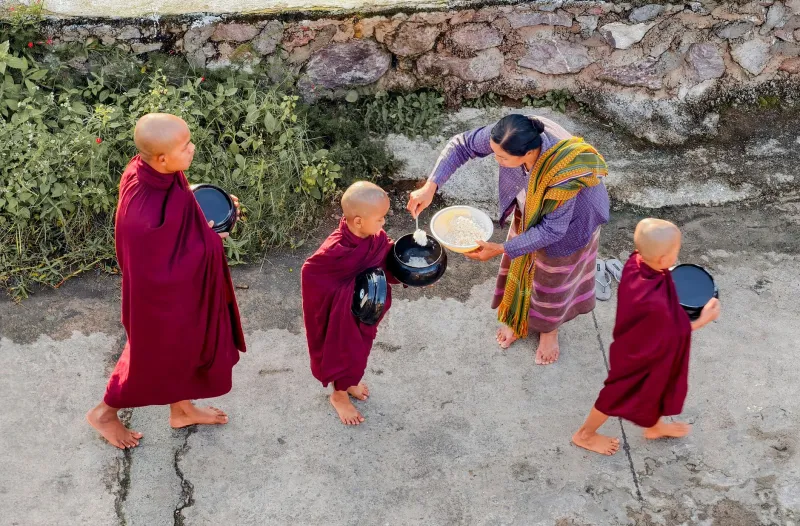
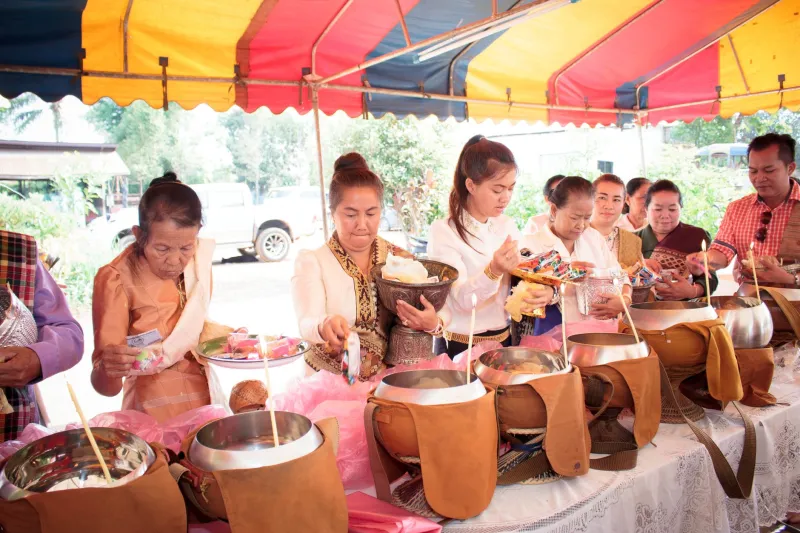
Few customs illustrate the community-building power of Thai temple life more vividly than the communal meal. In Thailand, preparing and offering food to monks is among the most common expressions of merit-making, and this tradition travels intact to America. On weekend mornings at temples throughout the country, laypeople arrive early to cook elaborate dishes — curries, soups, rice preparations, sweets — which are first offered to the resident monks before being shared among everyone present.
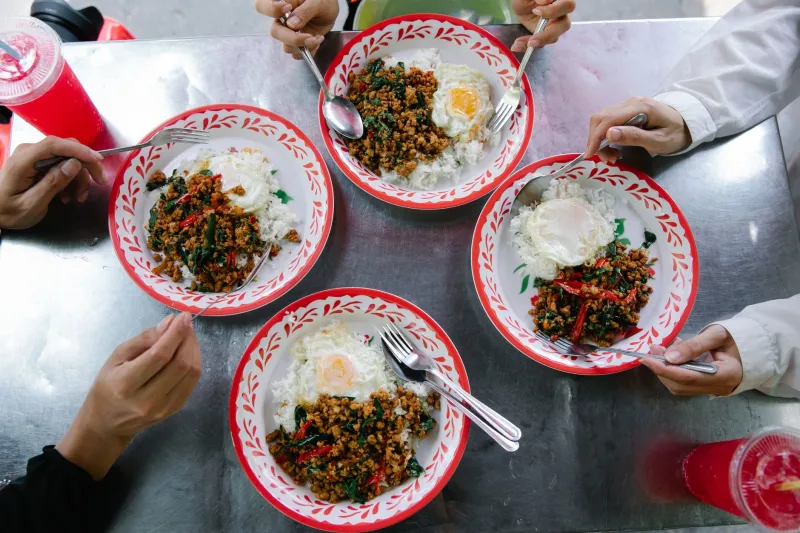
These meals are not merely practical. They are social architecture. The act of cooking together, of carrying dishes and arranging tables, creates the low-stakes, side-by-side interaction that social scientists identify as foundational to lasting friendship. Conversations begin over a pot of tom kha and continue through dessert. Children play in adjacent spaces while parents exchange advice about schools, doctors, and navigating the American bureaucratic landscape.
For newcomers especially, these gatherings offer something difficult to find elsewhere: a space where their language, their food, their cultural references, and their spiritual assumptions are entirely at home.
Festivals as Community Anchors
Beyond the weekly rhythm, the Thai Buddhist calendar provides a series of larger gatherings that function as genuine community anchors throughout the year. Songkran, the Thai New Year celebrated in April, draws hundreds — sometimes thousands — of participants to temple grounds across major American cities. Visakha Bucha, commemorating the birth, enlightenment, and passing of the Buddha, brings communities together for candlelit evening ceremonies of particular beauty and solemnity. Kathina, the post-rains robe-offering ceremony in the autumn, involves weeks of collective preparation and fundraising that deepens social bonds through shared purpose.
These events also serve an important function for second-generation Thai Americans, many of whom feel the tension between their heritage and the dominant culture they navigate daily. At the temple festival, they encounter Thai identity as something vibrant and celebratory rather than merely nostalgic. They see their parents and grandparents as full participants in a living tradition, not simply as people from somewhere else.
Practical Pathways for Newcomers
For those who are new to a Thai Buddhist community — whether recent immigrants or Americans of any background drawn to Thai Theravada practice — the path to meaningful participation is more accessible than it might appear.
Most Thai temples in the United States welcome visitors warmly and without expectation. Arriving on a Sunday morning, dressing modestly, removing shoes before entering temple buildings, and simply observing the morning offering and chanting is entirely appropriate for a first visit. Many temples post their schedules on websites or social media, and several maintain active Facebook groups or LINE group chats where community announcements and informal conversation flow continuously.
Volunteering for festival preparation is among the fastest ways to move from visitor to participant. The work is practical, the atmosphere is friendly, and the shared effort creates the conditions for real conversation. Cooking teams, decoration crews, and parking volunteers all find themselves embedded in the social fabric of the community far more quickly than those who attend only as observers.
Language classes, meditation instruction, and Dhamma study groups offered by many temples provide additional entry points that suit different temperaments and schedules.
Emotional Support When It Matters Most
Perhaps the most profound function of the temple community becomes visible during moments of difficulty. When illness strikes, when a family member passes away, when a marriage dissolves or a job is lost, the sangha mobilizes in ways that formal institutions rarely can. Meals are prepared and delivered. Transportation is arranged. Children are looked after. Monks offer prayers and counsel.
This network of mutual care is not incidental to the Buddhist life — it is an expression of it. The Dhamma teaches that suffering is universal and that compassion is the appropriate response. In the Thai temple community, this teaching takes practical, human form.
"When my mother died, people I had known for only two years treated me like family," says one community member in the Dallas area, who asked to remain anonymous. "I did not have to ask for anything. They simply came."
An Invitation
The sangha that Thai Buddhist temples are building across America is not a relic of the old country preserved in amber. It is a living, adaptive community that meets people where they are — spiritually, culturally, and emotionally — and offers them a place to belong. For those who have yet to find their way through the temple gate, the invitation is open, the meal is warm, and the welcome is genuine.