Between the Sacred and the Balance Sheet: How Thai Buddhist Temples Survive in the American Economy
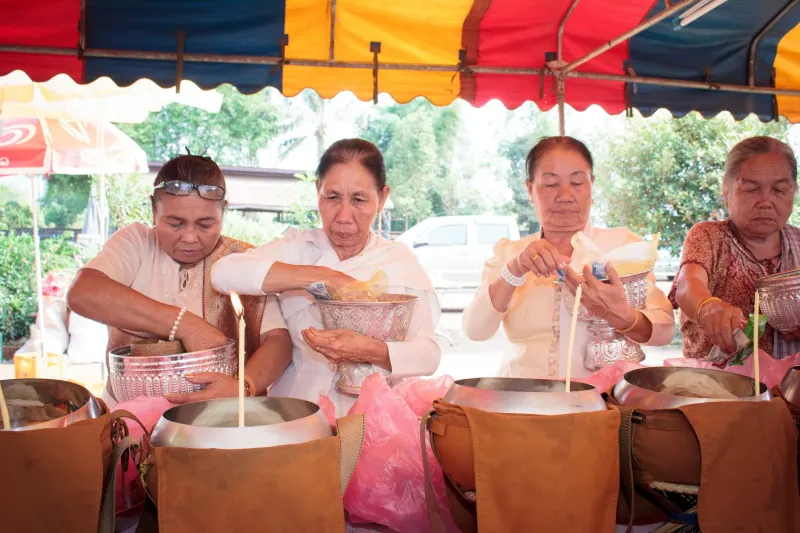
On a Saturday morning in a mid-sized American city, the parking lot of a Thai Buddhist temple fills not with meditators but with browsers. Folding tables stretch across the courtyard, weighted down with curry puffs, mango sticky rice, handmade amulets, and secondhand goods. Children chase each other between the tables. Elderly Thai women in traditional dress negotiate prices in a mixture of Thai and English. At the edge of the activity, a monk stands quietly, accepting offerings with a measured stillness that seems to belong to a different time entirely.
This is the American temple festival — part fundraiser, part cultural celebration, part community anchor. It is also, increasingly, a financial lifeline.
The Economics of Sacred Space
The decision to establish a Thai Buddhist temple in the United States is, at its heart, a spiritual one. But the decision to sustain one is, unavoidably, an economic one. Property in American cities is expensive. Maintenance is expensive. Utilities, insurance, staffing, and the thousand small costs of operating a physical institution in one of the world's most expensive economies are all expensive. And the traditional Thai Buddhist model of community support — in which monks receive what is freely offered, and temples are sustained by the generosity of the faithful — does not always translate cleanly into the American context.
"In Thailand, the relationship between the temple and the community is woven into the fabric of daily life," explains one temple administrator who has managed operations at a Thai Buddhist center in the Southeast for more than a decade. "People give because it is natural, because it is how things have always been done. Here, you have to build that culture from scratch, often with a diaspora community that is already stretched thin between two worlds."
The result is a landscape of creative adaptation. Across the country, Thai Buddhist temples have developed fundraising models that range from the straightforward to the surprisingly entrepreneurial — and that sometimes generate their own set of tensions.
From Bake Sales to Real Estate: The Fundraising Spectrum
At the most accessible end of the spectrum are the food festivals and cultural events that have become fixtures at Thai temples across America. These gatherings serve multiple purposes simultaneously: they raise funds, they maintain cultural connection for Thai-American families, they introduce non-Thai neighbors to the community, and they create the kind of joyful, shared activity that sustains belonging over time.
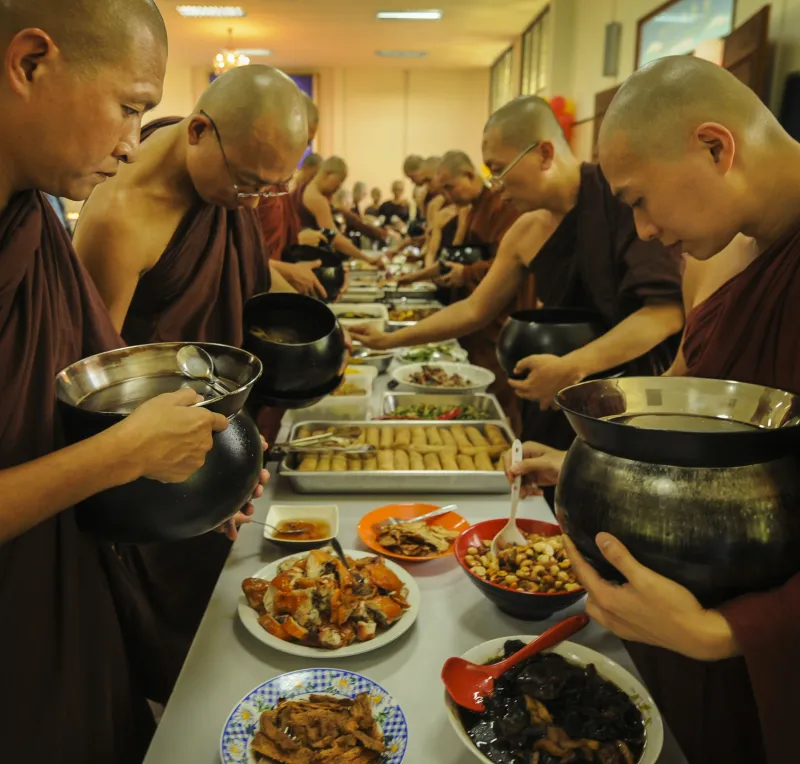
Food is particularly central to this model. Temple kitchens, staffed largely by volunteer upasikas — lay women who have taken precepts — produce dishes that carry both culinary and cultural significance. The act of cooking for the temple is itself understood as a form of dana, of generosity, which means that the fundraising activity and the spiritual practice are, ideally, inseparable.
But food sales and festivals, however beloved, rarely cover the full cost of operating a temple property in an American city. Larger temples have turned to more substantial revenue strategies. Some rent portions of their facilities for community events, yoga classes, or cultural programs. Others have developed retreat programs that draw practitioners from beyond the immediate Thai-American community, effectively functioning as small hospitality operations.
A handful of temples have pursued real estate as a long-term strategy — acquiring adjacent properties that can be rented to generate stable income, or developing underused land for community housing. This approach, while pragmatically sound, can generate philosophical discomfort within communities that associate renunciation with simplicity.
"There are elders in our community who are genuinely troubled by the idea of the temple as a landlord," acknowledges one temple board member. "The conversation about what is appropriate — what serves the community and what compromises the spirit of the place — is ongoing. It should be ongoing."
The Tension at the Center
The most honest conversations about temple finance tend to acknowledge a tension that is not easily resolved: the tension between the spiritual logic of dana — which is unconditional, unmeasured, and untethered to commercial exchange — and the operational logic of a nonprofit institution in a capitalist economy, which requires planning, budgeting, and the cultivation of reliable revenue streams.
This tension is not unique to Thai Buddhist temples. Houses of worship across traditions navigate it constantly. But it has a particular texture within the Buddhist context, where the teachings themselves are so explicit about the dangers of attachment to material accumulation — even when that accumulation is undertaken in service of the Dhamma.
"We talk about this in our board meetings more than almost anything else," says the administrator of a Thai Buddhist temple in the Southwest. "How do we raise what we need without turning the temple into a business? How do we ask for support without making people feel like they are customers? These are not small questions."
Some communities have found that transparency itself is a form of trust-building. When temple leaders share openly with their congregations — presenting clear accounts of what the temple costs to operate, what it has and what it needs — the response is often more generous than anticipated. People give more freely, it turns out, when they understand what their giving makes possible.
What the Community Carries
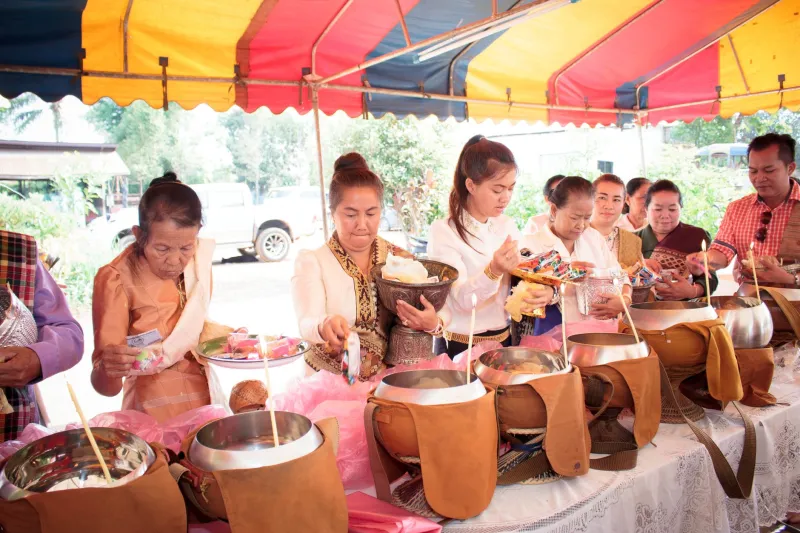
Perhaps the most striking aspect of Thai Buddhist temple finance in America is how much of it rests on the shoulders of ordinary community members — people who show up on weekends to cook, to clean, to staff tables at festivals, to drive elderly members to events, to donate time and skill and money in ways that never appear in any budget line.
This invisible economy of care is, in many ways, the real financial foundation of the temple. It is also the most direct expression of what the Thai concept of sangha — community — actually means in practice: not an institution, but a living network of mutual support, animated by shared commitment to something larger than any individual member's interests.
"The temple survives because people love it," says one long-term community member simply. "Not because of the fundraisers, not because of the events, though those matter. It survives because people cannot imagine their lives without it, and so they do whatever is necessary to keep it alive."
In that sense, perhaps, the economics of the American Thai Buddhist temple are not so different from the economics of any community built around genuine belonging. The balance sheet is real, and it must be balanced. But the deeper accounting — the one that measures what a place of practice and refuge is worth to the people whose lives it holds — operates by a different logic entirely. And it is that accounting, ultimately, that keeps the lights on.