Chopping Vegetables as Spiritual Practice: The Hidden Dhamma of Temple Service
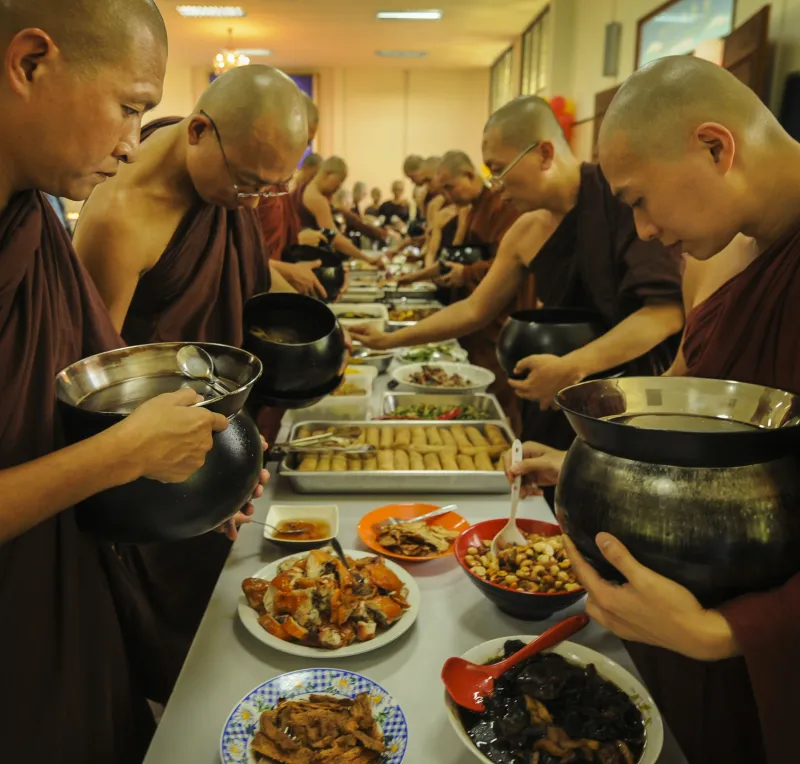
Photo: Buddhist temple volunteers cooking food preparation community kitchen, via get.pxhere.com
4 A.M. and the Work Has Already Begun
The shrine room is still dark. The monks have not yet risen for morning chanting. But in the kitchen of the temple, a light is already on, and two women are moving quietly around a stainless steel counter, beginning the work that will feed sixty people by noon.
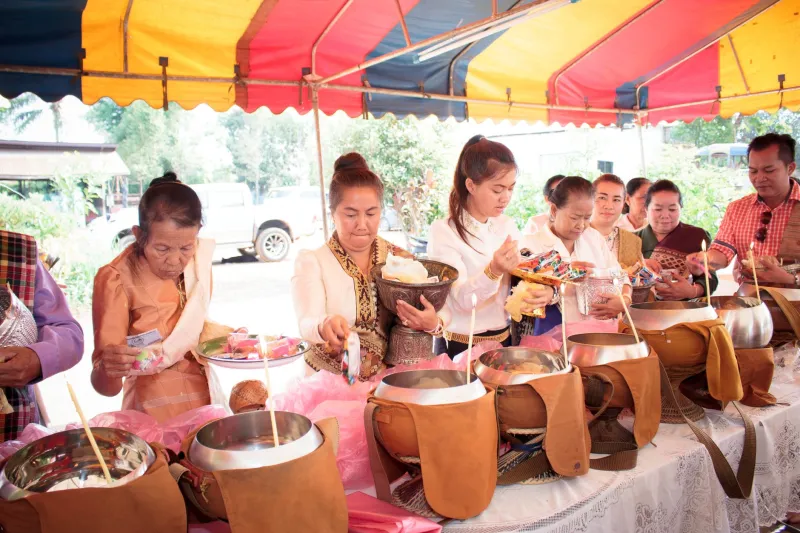
This scene repeats itself every weekend at Buddhist temples across the United States — in converted warehouses in Houston, in suburban ranch houses in Minneapolis, in purpose-built monastery halls in rural California. The faces change. The dishes change. The languages spoken over the cutting boards shift from Thai to Lao to Burmese to English. But the essential gesture is always the same: people giving their time, their energy, and their skill in service of something larger than themselves.
At Wat Pah Sunan, this culture of service is not incidental to the community's spiritual life. It is one of its primary expressions.
What the Kitchen Teaches
Buddhist philosophy offers a rich vocabulary for understanding why service work carries spiritual weight. The concept of kamma — often translated as "action" and understood as the principle that intentional deeds shape both the actor and the world — places enormous significance on the quality of attention and motivation we bring to everything we do. It is not only formal meditation that generates kamma. Every action, undertaken with awareness and right intention, is a moment of practice.
The kitchen, viewed through this lens, becomes a laboratory for some of the most demanding teachings in the tradition.
Consider non-attachment. A volunteer who spends four hours preparing a dish she will never taste, that will be offered first to the monks and then distributed to whomever arrives, has no personal claim on the outcome. The food is not hers. The praise — if there is any — does not belong to her. The practice is in the giving itself, clean and complete, without grasping at recognition.
Consider right livelihood. The precept asks practitioners to engage in work that does not harm others and that contributes positively to the world. Temple service is livelihood in its purest form: work done not for wages or status but for the direct benefit of the community and the tradition.
Consider mindfulness. Chopping a hundred stalks of lemongrass with full attention, without distraction, without impatience, is not a lesser practice than following the breath in a meditation hall. It is the same practice, wearing different clothes.
The Invisible Architecture of Community
Temple volunteers rarely appear in photographs. They are not the subject of dharma talks. Their names do not appear in programs or announcements. And yet without them, the entire visible life of the temple — the ceremonies, the teachings, the communal meals, the festivals — would simply not be possible.
Pim, who has volunteered at her temple in the Dallas–Fort Worth area for nearly twelve years, describes her service work in terms that are quietly theological. "When I am cooking for the monks and for the community, I feel like I am participating in something that has been happening for 2,500 years," she says. "The same offering, the same intention. That continuity means something to me. It connects me to something much bigger than my own little life."
Her daughter, who grew up watching her mother rise before dawn on temple days and return home in the late afternoon, initially saw the commitment as a burden. "I used to think she was giving up her weekends," she admits with a laugh. "Now I understand that those mornings in the kitchen are probably the most important thing she does all week. She comes home lighter. More herself."
Men, Maintenance, and the Dhamma of Details
Service work at American temples is not confined to the kitchen. Every functioning temple requires an enormous invisible infrastructure of maintenance, repair, landscaping, and logistical coordination. And while the kitchen volunteers are often predominantly women — reflecting cultural patterns brought from Southeast Asia — the maintenance crews and event logistics teams frequently draw in men who might not otherwise describe themselves as practitioners.
Somchai, a mechanical engineer who immigrated from Thailand two decades ago, spends one weekend a month doing electrical and plumbing repairs at his temple. He does not meditate regularly. He does not attend many dharma talks. But his commitment to keeping the physical temple in good repair is, by his own account, his primary practice.
"In Thailand, we say that when you build or maintain a temple, you are building merit that will carry you forward," he explains, adjusting a light fixture in the sala. "But I think it's more than that. When I'm working here, I'm not thinking about my problems at work or my mortgage. I'm just here, doing this thing that needs to be done, for this place that matters. That's a kind of freedom."
Service as the Gateway Nobody Talks About
For many members of Thai-American and broader Southeast Asian communities in the United States, temple service is the primary mode of engagement with the Dhamma. Formal meditation practice, while respected and encouraged, is not always the entry point — particularly for first-generation immigrants navigating demanding work schedules and family responsibilities.
The kitchen, the maintenance crew, the organizing committee for the next festival: these are the places where the community actually lives its values. Where generosity is practiced not as an abstract principle but as a concrete weekly act. Where the ego, with its preferences and its need for recognition, is quietly and persistently invited to stand down.
The tradition has always understood this. The Thai word for temple volunteer — ubasok for men, ubasika for women — carries genuine spiritual weight. These are not merely helpers. They are practitioners, walking a path that runs directly through the heart of the community they serve.
At Wat Pah Sunan, as at forest monastery communities throughout the country, this understanding is kept alive not in any formal curriculum but in the simple, repeated gesture of people showing up before dawn, tying on an apron, and beginning the work that makes everything else possible.