Shaving the Head in the Heartland: American Men Who Choose the Monastic Life
An Unlikely Vocation
In a country where individual achievement is celebrated above nearly all else, choosing to own nothing, live by 227 rules of conduct, and depend entirely on the generosity of others for one's daily meal is not an obvious life path. Yet for a small but growing number of American men, this is precisely the path they have chosen.
They come from places like suburban Ohio, coastal California, and the rural South. Some are recent college graduates still figuring out who they are. Others are men in their forties who built careers, raised families, and then found themselves standing at a threshold they could not explain to their colleagues or their neighbors. What they share is a decision to enter full monastic ordination within the Theravada Buddhist tradition — a commitment that, whether undertaken temporarily or for life, reshapes everything.
At temples like Wat Pah Sunan and similar forest monastery communities across the United States, these men are not anomalies. They are, increasingly, part of the fabric of community life.
Breaking the Lay Assumption
Popular American culture tends to imagine Buddhism as a practice for laypeople — something you do on a cushion before work, or during a silent weekend retreat, or through a carefully curated app. The monk, in this imagination, is a distant figure: serene, foreign, and largely symbolic.
This assumption has never accurately described the tradition. In Southeast Asia, monastic ordination — even temporary ordination lasting just a few weeks or months — is a normal and honored rite of passage for young men. It is how the Dhamma is transmitted, how merit is made, and how communities maintain their living connection to the teachings. The monastery is not peripheral to Buddhist life. It is its beating heart.
American converts and second-generation practitioners are beginning to recover this understanding. And for some, the recovery goes all the way to the robe.
Voices from the Robe
Brother Dhammavaro, who requested that his given name not be used, grew up in a mid-sized city in the Pacific Northwest. He describes his path to ordination as gradual — years of lay practice, then extended stays at monasteries in Thailand and the United Kingdom, then a period of deepening certainty that the monastic life was not simply something he admired from a distance but something he was being called into.
"People always ask me what I gave up," he says, seated in the simple guest room of the monastery where he has lived for three years. "But the question feels backward to me. The things I set down — the career ambitions, the accumulation of stuff, the constant negotiation with my own ego about status — those weren't possessions I was proud of. Setting them down felt like relief, not sacrifice."
His mother, a retired schoolteacher from Oregon who initially struggled with her son's decision, now visits the temple several times a year. "I didn't understand it at first," she admits. "In our family, you go to college, you build a life. But watching him over these years — watching how he's changed, how at peace he seems — I've come to see it differently. He's not hiding from life. He's living it more fully than most people I know."
The Weight of the Vinaya
Ordination in the Theravada tradition is not a casual undertaking. The Vinaya — the monastic code of discipline — governs virtually every dimension of a monk's life, from the way he eats to the way he speaks to the way he manages his possessions, which are few. For American men accustomed to the near-total autonomy of modern life, the adjustment can be profound.
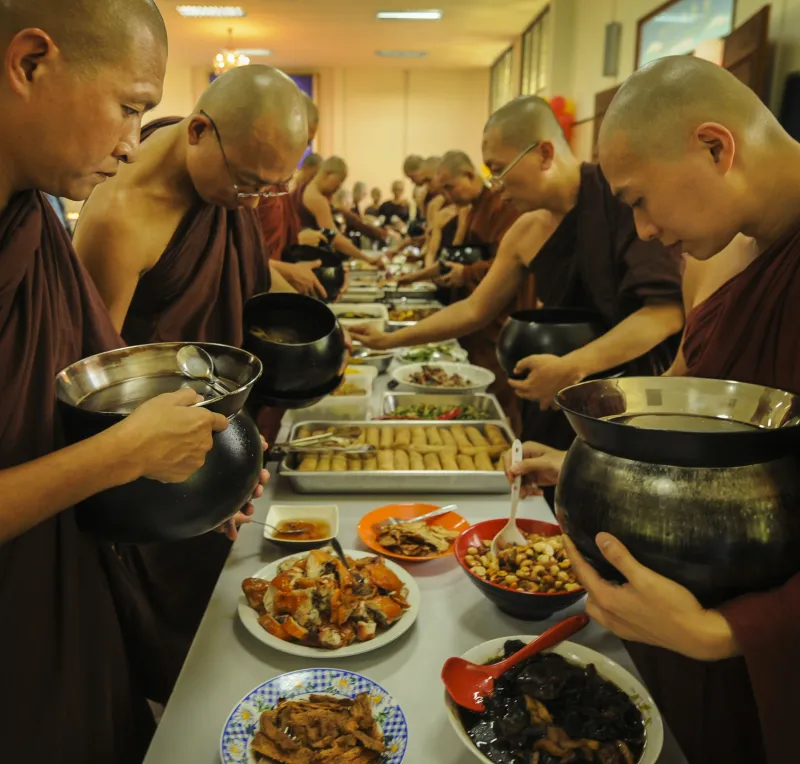
"The hardest part wasn't the early mornings or the one meal a day," says Phra Siripanyo, who was ordained at a temple in the American South after a decade of lay practice. "The hardest part was learning to receive. In America, we're trained to be self-sufficient. Accepting food from someone's hands, accepting their generosity without being able to immediately reciprocate — that cuts against something very deep in the American personality. And that's exactly why it's such powerful practice."
The Vinaya also requires monks to navigate American social contexts in ways that can be genuinely awkward — declining handshakes from women, explaining dietary restrictions, or appearing in public in robes in communities where the sight is entirely unfamiliar. Several monks described learning to hold these moments with lightness rather than anxiety, treating them as opportunities to represent the tradition with dignity rather than as inconveniences to be managed.
Families, Communities, and the Question of Belonging
For the families of American-born monks, the ordination of a son or brother can prompt a complicated mixture of pride, confusion, and grief. Some families come to embrace the monastic community as an extension of their own, participating in dana offerings, attending ceremonies, and finding in the temple a kind of spiritual home they had not previously known.
For Thai-American and other Southeast Asian communities, the presence of Western-born monks carries its own significance. It is at once a validation of the tradition's universal applicability and a reminder that the Dhamma belongs to no single ethnicity or culture. Several longtime temple members described a particular joy in seeing young American men take up the robes — a sense that the seeds their communities had planted in American soil were bearing unexpected and beautiful fruit.
A Path That Endures
Not every man who ordains remains a monk for life. The Theravada tradition has always accommodated temporary ordination, and many men who spend months or years in robes eventually return to lay life, carrying with them a depth of practice and perspective that reshapes everything that follows.
What endures, in every case, is the encounter with a way of life organized around something other than acquisition and achievement. In a culture that rarely offers young men any compelling alternative to those twin engines, the monastery stands as a quiet but radical proposition: that renunciation is not deprivation, that community is not confinement, and that the examined life — really examined, all the way down — is worth every inconvenience it requires.