From Silicon Valley to the Meditation Cushion: When Corporate America Meets the Dhamma
A Different Kind of Productivity Tool
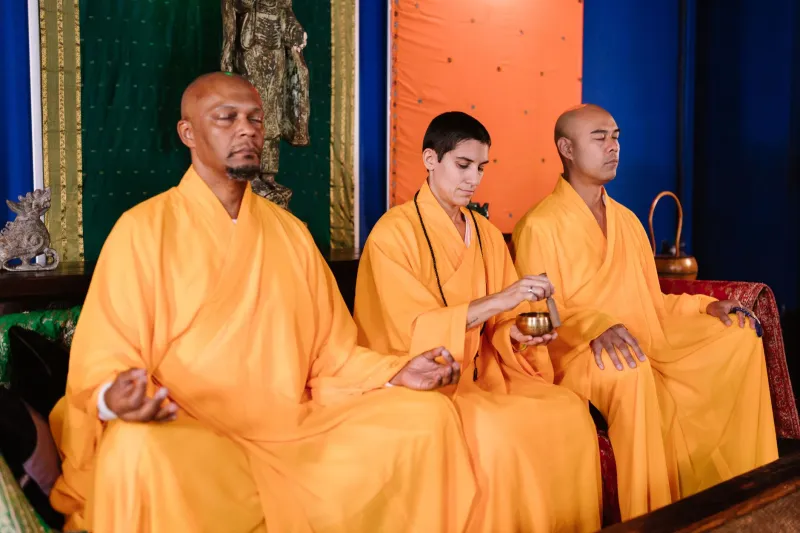
In the glass-and-steel towers of San Francisco, Seattle, and Austin, a new kind of meeting room has quietly emerged. Stripped of whiteboards and standing desks, these spaces hold only cushions, a small bell, and perhaps a single candle. Companies like Google, Apple, and countless startups have begun offering employees structured meditation programs, framing stillness as a competitive advantage in an industry that prizes relentless output.
For many tech professionals, the journey inward begins not at a temple but on a smartphone screen. Apps such as Headspace and Calm have introduced tens of millions of Americans to breath awareness and body-scan techniques drawn, however loosely, from the Theravāda and Zen traditions. The numbers are striking: the global mindfulness market is projected to surpass $9 billion by 2028, with corporate wellness contracts representing a growing share of that revenue.
Yet behind the polished interfaces and subscription tiers lies a lineage stretching back more than 2,500 years — one that teachers at temples like Wat Pah Sunan continue to transmit in its fuller, more demanding form.
What the Apps Don't Tell You
Phra Ajahn Somchai, a senior monk with more than two decades of teaching experience in the United States, chooses his words carefully when asked about mindfulness applications. "We are glad that people are learning to sit quietly and observe the breath," he says. "That is a genuine good. But the Buddha did not teach meditation as a stress-management technique. He taught it as a path to liberation from suffering itself."
The distinction matters. Classical Buddhist meditation — sīla, samādhi, and paññā, or moral discipline, concentration, and wisdom — forms an integrated whole. Corporate mindfulness programs typically extract samādhi practices while setting aside the ethical commitments and insight teachings that give them their full transformative power. A ten-minute guided session before a product launch meeting is a far cry from the sustained retreat conditions under which these methods were developed.
Several tech workers who have moved from apps toward temple practice describe a similar turning point: a moment when the app-delivered calm began to feel insufficient, prompting a search for something deeper.
Maya R., a software engineer based in the San Jose area who asked that her last name be withheld, began using a popular meditation app during the height of pandemic-era remote work. "It helped me sleep better and feel less reactive in meetings," she recalls. "But after about a year, I started wondering whether I was just managing my anxiety more efficiently, or whether something more fundamental could change." A colleague introduced her to a local Thai Buddhist temple, where she eventually took the Eight Precepts during a weekend retreat. "The experience was completely different," she says. "There was a seriousness to it, a sense that this practice had consequences beyond my quarterly performance review."
The Temple as an Unlikely Tech Hub
Some temples have responded to the surge of secular interest by opening their doors more deliberately to non-Buddhist visitors. Wat Pah Sunan and similar forest-tradition monasteries in the United States have seen a notable increase in retreat inquiries from professionals with no prior connection to Thai or Southeast Asian communities.
This openness carries both opportunity and responsibility. On one hand, exposure to authentic practice can redirect genuine seekers toward the full depth of the Dhamma. On the other, there is a risk that temples themselves begin to market their offerings in the language of wellness culture, inadvertently reducing the teachings to another self-improvement commodity.
Phra Ajahn Somchai is thoughtful on this point. "We welcome everyone who comes with sincerity," he says. "We do not ask people to become Thai or to adopt our culture. But we do ask them to respect the Dhamma as it is — not to reshape it entirely around personal comfort or professional goals."
Finding the Middle Path in Modern Life
The conversation around corporate mindfulness is not simply one of authentic tradition versus commercial dilution. Many practitioners and teachers acknowledge that even an imperfect introduction to meditation can plant seeds that eventually bear genuine fruit. The Buddha himself taught according to the capacities and conditions of his listeners, meeting people where they were.
What thoughtful observers in the Buddhist community tend to emphasize is transparency: being honest about what a given practice is, what it is not, and where a person might go if they wish to go further. A ten-minute breathing exercise is not the Noble Eightfold Path. It may, however, be a doorway.
For tech workers navigating burnout, anxiety, and the ethical complexities of an industry that shapes billions of lives, the Dhamma offers something that no productivity framework can replicate: a coherent account of why suffering arises, and a tested method for moving beyond it. Whether that encounter begins on a cushion in a corporate wellness room or on the polished floor of a temple meditation hall, what matters, teachers suggest, is the direction of travel.
As Maya puts it: "The app got me curious. The temple gave me a home."
An Invitation, Not a Warning
Wat Pah Sunan does not view the mindfulness movement with alarm. Rather, the community sees in it a reflection of a deep and widespread hunger — a recognition, however dimly articulated, that the pace and values of contemporary American life leave something essential unaddressed.
The Dhamma has always traveled. It moved from India to Sri Lanka, from Sri Lanka to mainland Southeast Asia, from Thailand to the forests and cities of the United States. Each journey brought adaptation. What has endured across every crossing is the core insight: that the mind, carefully trained and wisely guided, is the source of both our suffering and our liberation.
For those who have found their first taste of stillness through a smartphone app or a corporate retreat, the invitation stands: come and explore what lies beyond the ten-minute session. The cushions, the bell, and the teaching are here.