Taking the Robe in America: The Women Who Walk Away From Everything — and What They Find
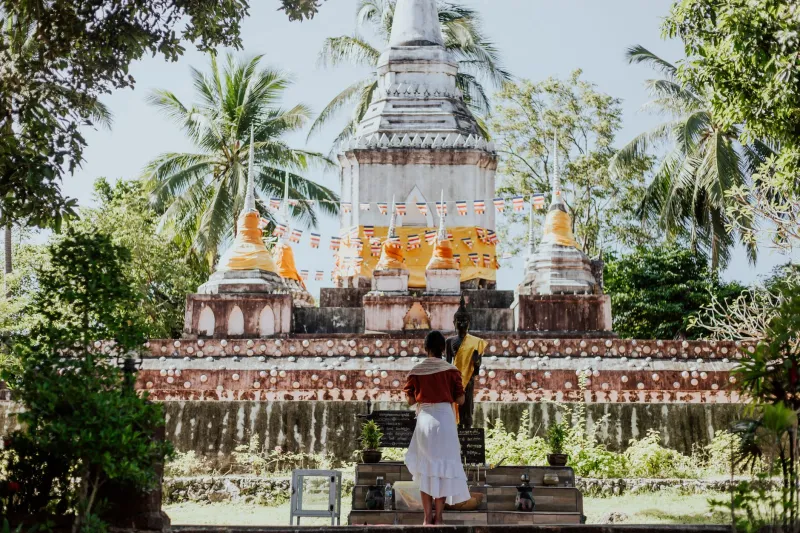
The ochre robe is not a costume. It is a declaration — one that carries centuries of meaning, and one that, when worn by an American woman in the twenty-first century, carries a particular weight of its own. It says: I have chosen this over everything else you expected of me.
Across the United States, a quiet movement is unfolding inside Thai Buddhist temples, forest monasteries, and retreat centers. Women — some in their twenties, others in their fifties — are taking monastic vows, shaving their heads, and stepping into forms of renunciation that their families, friends, and culture were entirely unprepared to understand. Their stories are not uniform. They are, in fact, strikingly varied. But they share a common thread: the experience of standing at the edge of a life fully constructed around conventional expectation, and choosing to step off.
Who Chooses the Robes?
The women who have entered or are considering monastic life within Thai Buddhist communities in America do not fit a single profile. Some came to the Dhamma through suffering — illness, loss, the quiet devastation of a life that looked successful from the outside and felt hollow within. Others arrived through intellectual inquiry, drawn first to Buddhist philosophy and then, gradually, toward the idea that understanding and practice were not the same thing.
"I had read everything," says one woman, a former academic who ordained as a mae chi — a white-robed nun in the Thai tradition — at a temple in the Pacific Southwest five years ago. "I had read Ajahn Chah, I had read Bhikkhu Bodhi, I had been on retreats. And I realized at some point that I was studying a map without ever committing to the journey. Ordaining was the decision to actually go."
For others, the path was more instinctive than intellectual. A woman who took novice vows at a Thai Forest monastery in the American South describes her decision as less a choice than a recognition. "I kept waiting for something to talk me out of it," she says. "Nothing did."
The Family Conversation Nobody Prepares You For
If the internal journey toward ordination is profound, the external one — the conversations with parents, partners, and siblings — can be equally demanding. In a culture where the measure of a life well-lived is often tallied in career achievements, relationships, and accumulated security, the decision to renounce those things entirely is not easily absorbed.
For American women specifically, the announcement of monastic vows tends to generate a particular kind of response: the assumption that something must have gone wrong. That the woman in question is fleeing something — a broken relationship, professional failure, depression — rather than moving toward something.
"My mother's first question was whether I'd been hurt by someone," recalls one practitioner who has maintained long-term precepts within a Thai Buddhist community in the Midwest for three years. "The idea that a person might choose this out of genuine aspiration, rather than escape, was very difficult for her to hold. It took a long time before she stopped waiting for me to come back."
This dynamic is not unique to American families. But it is inflected, in the American context, by a cultural narrative that places individual self-realization — understood as achievement and experience — at the center of a meaningful life. Renunciation, in that narrative, reads as self-erasure.
Gender, Tradition, and the Question of Full Ordination
The question of women's ordination within Theravada Buddhism — the tradition to which most Thai Buddhist temples in America belong — is one of the most complex and contested in contemporary Buddhist life. The bhikkhuni ordination, which would grant women full ordination equivalent to that of monks, was technically discontinued in the Theravada tradition for centuries, though revival efforts have been ongoing since the 1990s.
Most American women who ordain within Thai Buddhist contexts do so as mae chi, taking eight or ten precepts and wearing white robes rather than the ochre of fully ordained monks. Their status within temple communities varies considerably — at some temples, they are deeply respected teachers and integral community members; at others, they occupy more ambiguous positions.
"There are temples where I feel completely seen and supported," says one long-term practitioner. "And there are temples where the assumption is that women are here to help with the kitchen and the fundraising. Both exist. You learn to navigate."
Some American women have sought full bhikkhuni ordination through lineages that have revived the order — a decision that can place them outside the formal recognition of certain Thai ecclesiastical bodies, and that sometimes creates tension with more traditionally minded communities.
The teachers who have engaged most thoughtfully with this question tend to emphasize that the Vinaya — the monastic code — was always understood as a living framework, not a fixed decree. "The Buddha's intention was liberation," notes one senior teacher. "The forms through which that liberation is pursued must be suited to the beings who are pursuing it."
What the Robes Reveal About American Spiritual Seeking
The women who choose monastic life within Thai Buddhist communities in America are, in a sense, an extreme data point in a much larger story about the nature of spiritual seeking in contemporary American life. They represent the furthest expression of a longing that many Americans feel but few follow to its logical conclusion: the longing for a life organized entirely around what matters most.
In a society that offers an extraordinary abundance of options — and that has, in many ways, elevated optionality itself to a kind of virtue — the decision to close off every other path can read as either madness or profound clarity, depending on the observer.
For the women themselves, the distinction they consistently draw is between restriction and freedom. The robes are not, they say, a cage. They are a container — one that makes possible a depth of practice and presence that the unstructured life, for all its apparent freedom, rarely allows.
"People ask me what I gave up," says the former academic who ordained five years ago. "I find the question hard to answer. What I gave up was the constant negotiation — the endless deciding what to do next, who to be, what to want. The structure of this life makes the practice possible in a way that nothing else did for me."
Hers is not the only story. But it is, perhaps, the one that speaks most directly to what the robes mean when they are chosen freely, in full knowledge of what they cost — and what they make possible.